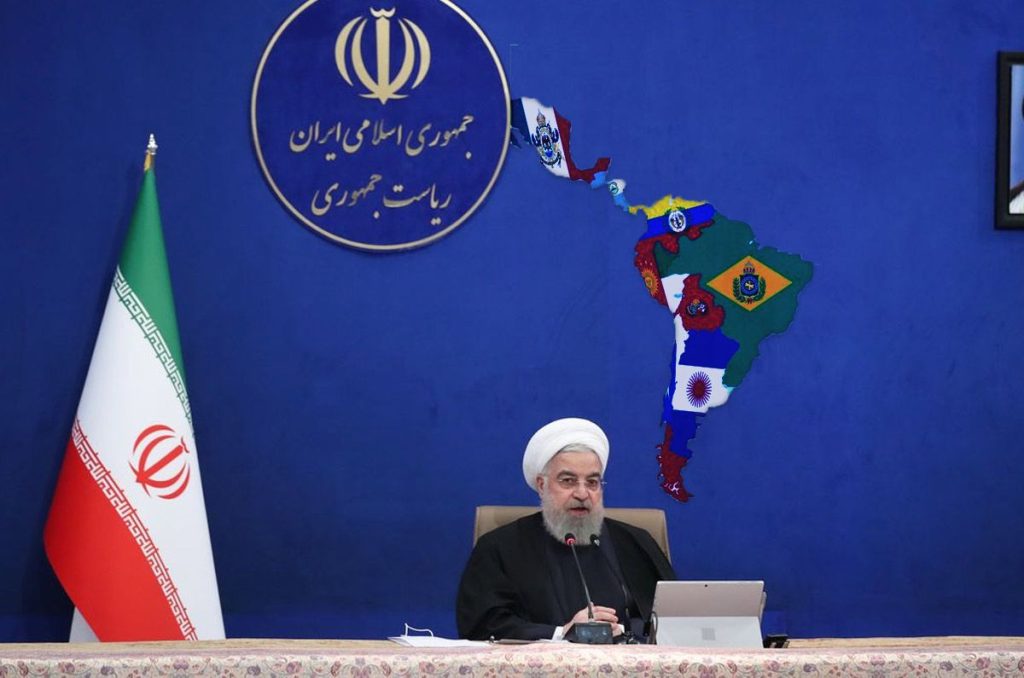
The latest US act of aggression against Iran has led many to fear that we are on the brink of another arbitrary war in the Middle East. The United States and Iran have had a long history of tension over nuclear proliferation, economic interests, a history of US influence in Iran’s domestic politics and US support for Iraq in the Iran–Iraq War. On 3 January 2020, US President Donald Trump launched a strike that killed Qassim Suleimani, the Iranian major general of the Islamic Revolutionary Guard Corps. This hostile US act has heightened the turmoil between the two countries. In addition, Iran’s relations with Latin America have acted as another source of fear for the United States. Iran’s particularly close economic ties with countries such as Brazil, Argentina and Uruguay have prompted different reactions among Latin American leaders to the recent escalation.
The United States has emphasised the unity of the Western Hemisphere since the Monroe Doctrine in 1823 in order to prevent Eastern influence from reaching the United States. In doing so, the United States also united North and South America under new democratic, revolutionary and anti-colonial values. The United States has justified intervention in Latin America on the idea that external influence is dangerous and unwanted. The United States has consistently feared the influence of other nations in the region, including that of the Soviet Union in Cuba. Iran’s economic relations with Latin American countries will prove to be another test of what the United States is comfortable with in the Western Hemisphere.
In recent years, Iran has established economic relations with Latin American countries because of the great wealth of resources among these nations. “On 21 August, Iranian Foreign Minister Javad Zarif held talks with senior officials from six Latin American countries, including Bolivia, Chile, Cuba, Ecuador, Nicaragua and Venezuela, to promote political and economic ties” (Lofaso 2016). The growth in economic ties contrasts with the US approach to Iran, in which the United States has increased economic sanctions on Iran as a way of penalising the country for its continued interest in nuclear proliferation. However, the expansion of US sanctions serves precisely as a justification for Iran to move closer to other countries, such as those of Latin America, which have also suffered US economic and political imperialism, in order to work together. Iran has built firm relations with Brazil, Argentina, Venezuela and Bolivia. Iran and Venezuela have invested in each other’s economic projects and have supported each other ideologically. In response, Venezuela has recently come out in defence of Iran over the recent US attacks, while other Latin American countries are divided or, in the case of Brazil, on the side of the United States.
Although Brazil’s right-wing president, Jair Bolsonaro, has aligned himself with Trump and the United States, Brazil remains Iran’s main trading partner in Latin America, followed by Uruguay and Argentina (Lissardy 2020). Iran initially began to rebuild its relations with Latin American countries during the pink tide, a period in which left-wing governments in Latin America won political office. These left-wing governments were politically favourable to Iran, with which they shared similar ideas of government and anti-American sentiment. However, Brazil, Argentina and Uruguay are examples of where the pink tide has receded, especially in the case of Brazil, where relations with the United States have flourished again. According to Lissardy, these relations have been tremendously beneficial for the Latin American countries. “Bolsonaro’s Brazil last year had a surplus of more than US$2 billion in trade with Iran, one of its main destinations in the world for agricultural and animal protein exports” (Lissardy 2020). As tensions between the United States and Iran continue, Brazil may be told that it must choose between being a political ally of the United States or an economic partner of Iran. However, Bolsonaro has not yet yielded to this, and stated on Tuesday that economic relations between Brazil and Iran will continue (Lissardy 2020). This may be a sign that Iran and other Latin American countries are willing to set aside political differences for the mutual benefit of their national economies. This is probably due to the importance of the agricultural sector to Brazil’s economy. “On 15 November, a Brazilian ship arrived at Chabahar, Iran’s only ocean port, carrying 72,000 tonnes of bulk maize from Brazil. A year earlier, a Brazilian ship, the Living, carried 66,000 tonnes of sugar to Chabahar” (Aman 2018). Iran has acted as an important trading partner and consumer of Brazilian agricultural products.
While economic cooperation between Iran and Latin American countries is useful, it raises the question of how far these relations extend. On 10 November 2018, a Brazilian senator told the speaker of Iran’s parliament that Brazil, with the support of Russia, India, China and South Africa, “would stand by Iran in the face of US sanctions” (Aman 2018). However, Bolsonaro’s political relationship with Iran has been less friendly. Although Iran is economically important to Brazil, the Bolsonaro administration has indicated that ties with Iran are likely to diminish. Iran and Brazil also clashed last year after Brazil refused to refuel two Iranian ships because of US sanctions. Iran claimed that these ships were loaded with maize, while others speculated that they instead contained urea, which can be used to make explosives. “The Iranian ambassador to Brazil, Seyed Ali Saqqayian, said his country could find new suppliers of maize, soya and meat” (O’Connor 2019). The seemingly fractured economic relationship between Iran and Brazil has also been mirrored in other Latin American states, including Argentina, which have decided to side with the United States.
Although the economic relationship between Iran and Brazil gives Iran a foothold in the Western Hemisphere, it does not appear that Iran can exert much political influence during the Bolsonaro administration. However, with the US presidential election coming up in 2020, this year, relations between the United States and Brazil could change, which would affect the economic relationship between Brazil and Iran.