
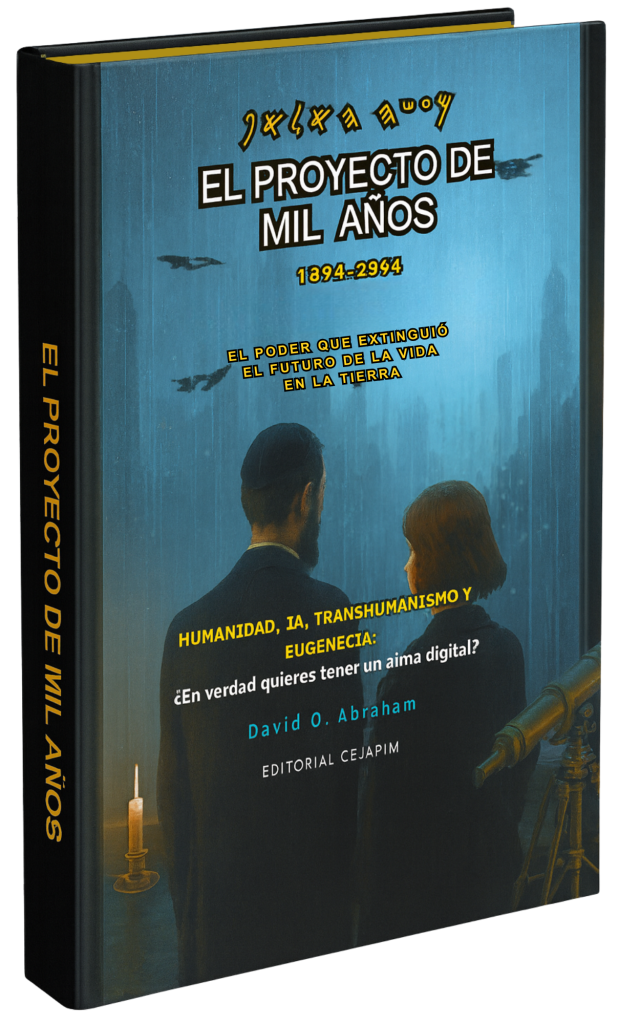
Novel · CEJAPIM Publishing
Take on the challenge of discovering the future of humanity: Are you prepared to accept a future in which your child or grandchild will be born in the womb of a machine and not in the womb of your wife?
The year is 2025. Behind the façade of progress, equality and human rights, a global network is working in silence to redesign life on Earth. When David Ben-Ari, an investigative journalist in New York, uncovers the origin of the TÉLOS Consortium —an organisation that, for more than a century, has been driving the total redesign of the human species and of every form of life towards the year 2994 — his life and that of his family change for ever. What begins as a sensationalist report becomes a moral and spiritual search for the very meaning of existence. With the support of his wife Etla, David traces the decisions that seek to turn human beings, and biology in general, into a managed project: a future in which life is programmed, consciousness is edited and death is administered as a service.
Between real conspiracies and ethical dilemmas, The Thousand Year Project combines the lucidity of Asimov, the irony of Huxley and the moral warning of Orwell. But it goes much further: it stands as a forceful refutation of Michel Foucault’s system, challenging the dominance of biopower and the total rationalisation that seeks to banish metaphysics from human debate. It shows, with historical facts, that the final battle will be neither political nor technological, but existential… the moment when humanity will play at being god and decide whether creation deserves to stay alive or to be replicated. A novel of suspense, history, science and mysticism that forces us to ask ourselves: how far can human beings go before erasing their own soul… and that of their world?
Readers’ frequently asked questions
What is The Thousand Year Project really about?
It is a novel that stages, with academic rigour, the possible future of humanity. It analyses how politics, philosophy and science have gradually redefined ethical boundaries in order to control human beings. It explores how technology, memory and power can transform what is human when those boundaries dissolve, all through fictional characters whose experience conveys their emotions directly to the reader.
Is it a classic dystopia?
No. Although it includes dystopian elements, the novel moves away from the clichés of the genre. Its aim is to show, in the style of the great classic works, how the processes that dehumanise human beings and their environment have evolved gradually. It does so in an immersive way, inviting readers to discover and connect, through their own analysis and judgement, the historical and social threads that have shaped this transformation.
What role does Jewish culture play in the novel?
Jewish culture provides an ethical, historical and symbolic framework, enriched by elements of Kabbalah, which offers a perspective uncommon in the Western world on how to face technological advances without losing the essence and identity of the individual and their community. The work shows how traditions, memory and resilience influence the understanding of what is human, intertwining with characters and events to create a counterpoint that invites reflection on cultural continuity in the face of technological and social change.
Does the book criticise transhumanism?
It questions it with seriousness and sensitivity. The work does not preach; instead, it shows what could be lost when what is human becomes a technical project rather than a shared mystery. The reader decides where to draw the line.
Does the novel contain a lot of historical and scientific information?
Yes, and that is one of its greatest strengths. The author gave priority to academic rigour in every field it addresses —scientific, political and philosophical— so that the novel is enriching not only on a literary level but also on an intellectual one. Advances and concepts are woven organically into the story, through meaningful dialogues and scenes, allowing readers to experience them emotionally and ethically while absorbing decades of knowledge summarised and explained in a clear and accessible way. This combination of academic rigour and immersive narrative is a distinctive hallmark that makes the publisher proud and makes the reading unique.
What kind of reader would enjoy this novel?
This work is ideal for readers interested in narratives that combine academic rigour and literature, offering philosophical depth, historical context and political and scientific analysis. It provides an intellectually stimulating read, able to connect technological and social developments with human experience in a clear and documented way.
Is it a difficult read?
No. The language is elegant but accessible. The complexity lies not in the words, but in what they suggest and reveal. The book accompanies the reader; it does not abandon them.
What makes this book different from other futuristic novels?
The novel stands out for interweaving intimacy and the future with academic rigour: it combines literary narrative with historical, political and scientific analysis, showing how technological and social advances affect what is human and morality. It also incorporates the outlook of Jewish culture and Kabbalistic concepts little known in the West, offering an ethical and symbolic framework that enriches the story and prompts deep reflection in any reader, regardless of their cultural or religious background.
What was the author’s philosophical intention?
The novel was conceived as a falsifiable philosophical experiment that responds to contemporary theories of analytic and continental philosophy, such as Foucault’s theory of biopower, which influence global decisions and promote the idea that systems of social and technological control can reduce what is human to metrics, protocols or administrative structures, neutralising the relevance of metaphysical concepts such as the soul. Because it was written according to the criteria of the Humanist Philosophical School of the Limit and deliberately with a specific Kabbalistic grammar, in addition to the physical dimensions of the book and meta-acrostics that were implemented following concepts of gematria, its complete content and message cannot be fully translated or processed in their entirety in a digital version. Even if there are digital copies or translations with the same number of pages and letters, none conveys all the essential information of the work, which was written in Spanish, because any attempt to modify it loses the ‘soul’ that resides in its original composition. This limitation turns the very existence of the book into philosophical evidence of what is human, demonstrating that its essence transcends physical or digital form, and, through its mere existence, it provides a framework for reflecting on the limits of consciousness, ethics, identity and the preservation of the intangible in the face of attempts at total control.
Is this a religious novel?
No. Although it incorporates elements of Jewish culture and Kabbalistic concepts, the work has a philosophical, intellectual and cultural focus. These elements are used as symbolic and ethical tools to enrich the narrative and explore universal themes such as identity, memory, morality and the limits of what is human, without promoting any religious belief or ritual practice. This neutrality ensures that the work meets the criteria necessary to be taken seriously in academic analysis and debate, and prevents the underlying message from being conditioned by the reader’s theological perspective.
Does the book leave a final message?
More than a message, it leaves an echo: the question of whether it is still possible to defend what is human when the future seems already written. That echo invites us to keep reading, thinking and remembering that what is most fragile may also be what is most necessary.
Book details
- Number of pages: 27 chapters over 270 pages
- Publication date: 8 December 2025
- Dimensions: 8.5 x 5.5 inches.
- Paper type: Cream / white
- Cover types: Paperback / Hardback